RVault Box RVault Box

Top Fire Rating vs Burglary Rating What Is the Difference?

Time:2026-09-22 Author:Henry
0%

What is the difference between fire rating and burglary rating? This question matters when a safe protects irreplaceable documents, cash, jewelry, or digital storage media. These ratings measure different threats. A fire rating measures how long a safe limits heat exposure. A burglary rating measures resistance to forced entry, tools, attack time, and construction weaknesses.

John Drengenberg, former Consumer Safety Director at UL, explained it clearly: “A fire-resistant safe is not necessarily burglary-resistant.” That distinction remains practical. A safe may withstand a high-temperature fire while offering limited protection against drilling or prying. Another model may resist aggressive attacks but provide little insulation for paper records.

Industry data shows why both risks deserve attention. The National Fire Protection Association reported approximately 1.39 million fires in the United States during 2023. Those fires caused about $23.7 billion in direct property damage. The FBI’s 2023 Crime Data Explorer also recorded more than 847,000 burglary offenses nationwide. These figures describe broad risks, not the exact danger facing every household or business.

Fire tests commonly examine internal temperature over a defined period. Burglary tests examine physical resistance under specified attack conditions. UL 72 addresses fire-resistance performance for record protection. UL 687 covers burglary-resistant safes and vault equipment. Ratings are useful, but labels can still confuse buyers. Real protection depends on installation, anchoring, location, and the valuables stored inside. This introduction may simplify a technical subject. Yet that limitation is worth acknowledging. A carefully chosen safe should match the most realistic threat, not merely the most impressive rating.
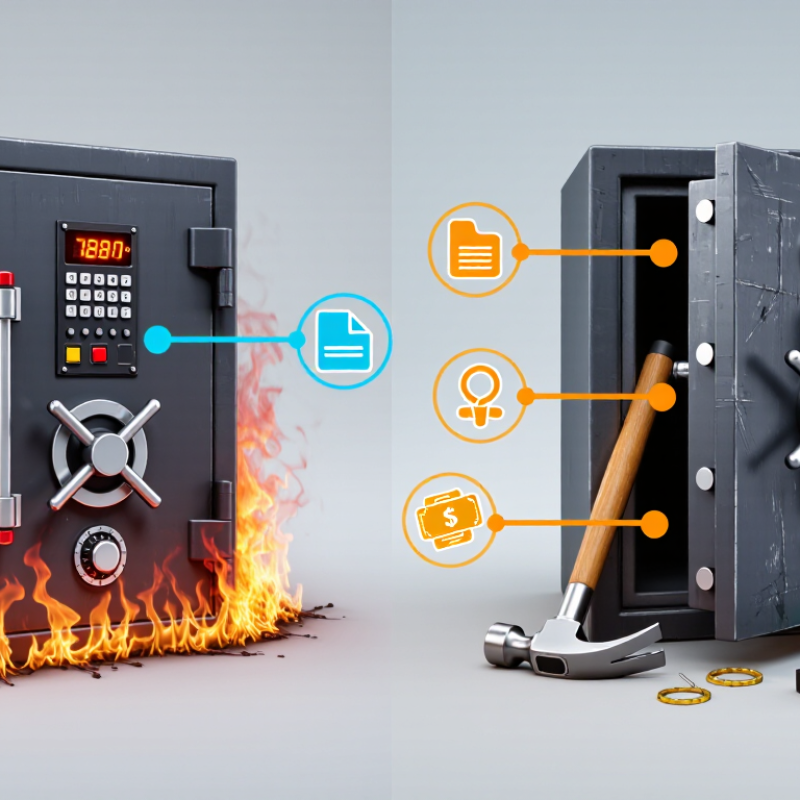
Top Fire Rating vs Burglary Rating What Is the Difference?

Defining Top Fire Ratings: UL 72 Class 350 and EN 1047-1

Top Fire Rating vs Burglary Rating: What Is the Difference?

Defining Top Fire Ratings: UL 72 Class 350 and EN 1047-1

Fire ratings measure heat protection, not resistance against forced entry. UL 72 Class 350 limits the internal temperature to about 350°F during a controlled fire test. This level generally protects paper records from rapid thermal damage. The test also evaluates structural integrity, insulation, and cooling performance. Heat is the test.

EN 1047-1 uses classifications such as S 60 P and S 120 P for paper storage. The number indicates the tested fire exposure period in minutes. Its data-media classifications use stricter internal temperature limits, often near 50°C, because magnetic and digital media fail earlier than paper. These standards are not directly interchangeable. A 2023 National Fire Protection Association report recorded approximately 1.39 million fires and $23.2 billion in property damage in the United States. That data shows why tested protection deserves careful attention. Yet, a rating alone is not enough. Installation, floor loading, ventilation, and maintenance can reduce real-world performance.

Tips: Match the rating to the stored material, not the cabinet’s appearance. Request the complete test classification and exposure duration. Ask whether the protection covers paper, digital media, or both. Check burglary certification separately, because fire resistance does not measure attack resistance. A stronger lock cannot replace insulation. That difference matters.

Top Fire Rating vs Burglary Rating: What Is the Difference?

Fire ratings define resistance to heat and fire exposure. Burglary ratings evaluate resistance to forced entry and are assessed separately; neither rating replaces the other.

Comparison of published internal-temperature thresholds for paper-record protection. UL 72 Class 350 permits up to 350°F (approximately 177°C), while EN 1047-1 S120P limits the protected interior to 150°C during a 120-minute fire test. These are fire-test criteria, not burglary-security grades.

Comparing Fire Protection: UL 72 Rates Safes for 1–4 Hours

Top Fire Rating vs Burglary Rating: What Is the Difference?

Fire and burglary ratings measure different threats. A burglary rating focuses on resistance to forced entry, tools, locks, and attack time. A fire rating measures heat exposure and internal temperature control. Underwriters Laboratories Standard 72 tests record-protection equipment for one, two, three, or four hours. It also uses temperature classes, including Class 350 for paper documents. The internal temperature must remain below 350°F during the test.

That distinction matters in real storage rooms. In a reported building fire, flames may pass quickly, while heat and smoke continue damaging files. The National Fire Protection Association recorded about 1.39 million fires in the United States in 2023. The same report estimated $22.2 billion in direct property damage. Those figures show why time matters, but a rating is not a promise against every fire.

A four-hour rating does not automatically provide strong burglary resistance. Conversely, a heavily reinforced burglary container may offer limited protection for paper or digital media. UL 72 testing also separates paper, nonpaper records, and heat-sensitive media. A practical selection should match the contents, expected fire conditions, and installation location. This is where mistakes happen. Many buyers compare only the largest number.

Fire exposure tests are controlled, not perfect copies of a warehouse fire. Building materials, ventilation, water, falling debris, and repeated heat cycles can change performance. Reviewing the complete test classification with a qualified security professional remains wise. Safety decisions deserve more than a label.

Top Fire Rating vs. Burglary Rating: What Is the Difference? Comparing Fire Protection Under UL 72
Comparison Dimension Fire Rating Burglary Rating What the Rating Measures Practical Meaning for Buyers
Primary Hazard Heat and fire exposure Forced entry, drilling, cutting, prying, and tool attacks Fire ratings evaluate how well the safe protects its contents from heat and, in some classifications, moisture or impact conditions. Select a fire rating for records, documents, media, or other contents that could be damaged by heat. Select a burglary rating for protection against deliberate physical attack.
Main Testing Standard UL 72, Standard for Tests for Fire Resistance of Record Protection Equipment Commonly evaluated under burglary-resistance standards such as UL 687 or other recognized testing specifications Fire and burglary tests are separate evaluations with different test methods, equipment, and pass/fail criteria. A safe may have strong fire protection without having a certified burglary rating, or vice versa. One rating does not replace the other.
Typical Fire Classes Class 350, Class 150, and Class 125
The class identifies the maximum internal temperature permitted during the fire test.
Burglary classifications commonly use labels such as B-rated, C-rated, TL-15, TL-30, or higher classifications, depending on the applicable standard. Fire classes relate to internal temperature limits; burglary classes relate to resistance against specified attack tools, methods, and durations. Do not compare a fire class directly with a burglary class. They describe different types of protection.
One-Hour Fire Rating Designed to maintain the applicable UL 72 internal-temperature limit for approximately 1 hour under the specified fire test. Not indicated by a one-hour fire rating. Burglary resistance must be stated separately. The time refers to the duration of the fire exposure used in the test, not a guaranteed survival time in every real-world fire. Often considered for general paper records when the expected fire risk and response time justify approximately one hour of tested protection.
Two-Hour Fire Rating Designed to maintain the applicable UL 72 internal-temperature limit for approximately 2 hours under the specified fire test. Does not indicate resistance to a two-hour burglary attack. A longer fire-test duration generally provides more protection margin, but construction, installation, fire intensity, and exposure conditions still matter. May be appropriate where fire response may be slower or where the value and importance of records justify additional tested duration.
Three-Hour Fire Rating Designed to maintain the applicable UL 72 internal-temperature limit for approximately 3 hours under the specified fire test. Does not measure tool resistance, lock manipulation, anchoring, or physical attack performance. The rating addresses fire endurance only within the conditions of the applicable test program. Useful for high-value or difficult-to-replace records when extended fire exposure is a significant concern.
Four-Hour Fire Rating Where a product is specifically tested and listed for four hours, it is intended to maintain the applicable UL 72 internal-temperature limit for approximately 4 hours under the stated test conditions. Does not represent four hours of certified burglary resistance. Four-hour claims should be verified in the product’s certification, listing, or official test documentation rather than assumed from marketing language. Consider only when the documentation clearly identifies the applicable UL 72 class, test duration, and protected contents.
Internal Temperature Class 350: maximum average internal temperature of 350°F (177°C) for paper protection.
Class 150: maximum average internal temperature of 150°F (66°C), commonly relevant to magnetic or similar media.
Class 125: maximum average internal temperature of 125°F (52°C), commonly relevant to more heat-sensitive media.
Internal temperature is not the principal measure of burglary resistance. Different contents require different maximum-temperature limits. Paper, magnetic media, optical media, and other materials do not have identical heat tolerances. Check the protected-content classification, not only the number of hours.
Burglary Time Ratings Fire duration, such as 1, 2, 3, or 4 hours where specifically documented Examples include TL-15 and TL-30, which indicate tested resistance against specified attack methods for approximately 15 or 30 net attack minutes, respectively. Burglary “minutes” are controlled attack-test times and are not equivalent to uninterrupted real-world elapsed time. A higher burglary classification generally indicates a more demanding test, but the exact standard and scope must be confirmed.
Construction Features Evaluated Insulation, door and body construction, heat transfer, seals, and protection of the specified contents Locking mechanism, boltwork, barrier materials, door and body design, tool resistance, relocking features, and sometimes attack-area limitations Fire protection and burglary protection usually require different design priorities and materials. Heavy weight alone does not prove either a fire certification or a burglary certification.
Water and Smoke Protection May be addressed separately or under additional test requirements; a fire rating alone should not be treated as a waterproof or smoke-proof rating. Usually outside the core burglary-resistance rating Firefighting water, humidity, smoke, and sprinkler discharge can damage contents even when the container passes a fire test. Look for separate documentation for water resistance, smoke seals, and media-specific protection.
Certification Verification Verify the stated UL 72 class, fire-test duration, protected contents, and certification or listing documentation. Verify the exact burglary standard, classification, test duration, and whether the rating applies to the complete container. Terms such as “fireproof,” “burglar-resistant,” or “high security” may be marketing descriptions rather than independent certifications. Request test documentation and compare the rating with the actual risk, contents, location, and insurance requirements.
Can One Rating Replace the Other? No No Fire resistance and burglary resistance protect against different hazards and are measured independently. For combined risks, choose a container with documented fire and burglary ratings, or use layered protection with separate fire and security controls.
Important Note A stated fire duration is meaningful only when the applicable test class, contents classification, and certification documentation are identified. A burglary label is meaningful only when the testing standard and classification are clearly stated. Always verify current certification records before purchase or installation.

Measuring Burglary Resistance: EN 1143-1 Grades I–XIII

Top Fire Rating vs Burglary Rating: What Is the Difference?

Fire ratings measure how long a safe can protect contents from heat. Burglary ratings measure resistance against forced entry. These ratings answer different questions. A cabinet can perform strongly in one area and weakly in another. No single label covers both risks.

EN 1143-1 grades I through XIII indicate tested burglary resistance, with Grade I offering less resistance than Grade XIII. Independent testing assesses attack methods, tools, working time, and resistance units. Some classifications also consider partial access through additional testing. A higher grade means greater resistance under defined test conditions. It does not promise invulnerability. That distinction matters.

In practice, compare the EN 1143-1 grade with the value and type of property stored. Check the certificate, test scope, lock configuration, and installation requirements. Anchoring also matters, especially for smaller units that could be moved. A high-grade safe may still provide limited fire protection unless it has a separate fire classification. One detail is easy to miss: burglary grades do not automatically indicate protection for digital media, paper, or heat-sensitive materials. The framework is rigorous, but not flawless for every real-world situation. Review the actual threat, storage period, and building conditions before choosing.

UL 687 TL-15 and TL-30 Ratings: What Attack Tests Measure

Top Fire Rating vs Burglary Rating: What Is the Difference?

A fire rating measures protection from heat, smoke, and rising internal temperature.

A burglary rating measures resistance to forced entry.

These ratings answer different questions. UL 687 TL-15 and TL-30 ratings focus on attack testing, not fire endurance.

During a TL-15 test, trained testers use specified hand tools and powered equipment for 15 net minutes. They attack defined areas, such as the door, lock region, or seams.

TL-30 allows 30 net minutes under similar conditions. The goal is to create a qualifying opening, not simply to damage the surface. TL-30 generally offers stronger resistance, but it is not automatically twice as secure. Tool selection, construction, installation, and attack location still matter.

Tips:

Check whether the rating covers the complete safe or only a component. Confirm the tested size and configuration match your intended model. Ask for current certification details and professional installation guidance.

A fire-rated unit may resist heat well but offer limited tool resistance. A TL-rated unit may delay entry but provide little thermal protection. That distinction is easy to miss.

Ratings are useful evidence, not magic. In real assessments, users sometimes focus on the highest number and overlook anchoring, access control, or recovery plans. A careful review should consider the contents, building conditions, likely threats, and required response time.

Fire vs Burglary Ratings: Heat Exposure Versus Forced-Entry Resistance

A fire rating measures heat exposure, not resistance to forced entry. Underwriters Laboratories’ UL 72 standard evaluates how well a safe protects its contents during furnace exposure. A Class 350 rating limits the internal temperature to about 350°F, protecting ordinary paper. Some tests last 30, 60, or 120 minutes. That duration matters.

The heat rises quickly. ASTM E119 data shows furnace temperatures can reach about 1,000°F after five minutes and roughly 1,700°F after one hour. These figures explain why insulation, door seals, and internal temperature monitoring matter. They do not prove that a safe can resist a pry bar.

Burglary ratings measure a different threat. UL 687 classifications, such as TL-15 and TL-30, use trained testers, defined tools, and net working time. The number does not mean a thief will be stopped for exactly 15 or 30 minutes in a real building. It reflects controlled attack resistance. That limitation deserves attention. A strong burglary rating may offer little document protection during a fire, while a high fire rating may provide weak protection against drilling or prying. European EN 1143-1 testing also evaluates resistance units, tools, and attack methods, giving buyers another technical reference. In practice, the correct choice depends on heat exposure, attack risk, contents, and installation quality. Labels help, but they are not the whole risk assessment.

FAQS

What does a fire rating actually measure?

A fire rating measures heat protection, not resistance against forced entry. Heat is the test. It evaluates insulation, structure, and cooling performance during controlled fire exposure.

What does UL 72 Class 350 protect?

UL 72 Class 350 limits internal temperature to about 350°F during testing. It generally protects paper records from rapid thermal damage. It may not protect digital media adequately.

How do S 60 P and S 120 P classifications differ?

These classifications describe tested fire exposure periods for paper storage. S 60 P represents 60 minutes, while S 120 P represents 120 minutes. The classifications are not directly interchangeable with other systems.

Why do digital media need stricter fire protection?

Magnetic and digital media can fail at lower temperatures than paper. Some classifications keep internal temperatures near 50°C. A paper-rated cabinet may be unsuitable for hard drives or storage devices.

What does EN 1143-1 measure?

EN 1143-1 measures resistance against forced entry. Grades range from I to XIII, with higher grades generally showing stronger tested resistance. It does not automatically provide fire protection.

What do TL-15 and TL-30 ratings mean?

These ratings describe attack tests using specified hand tools and powered equipment. TL-15 allows 15 net minutes of testing. TL-30 allows 30 net minutes. Thirty minutes is not simply twice as secure.

Can one cabinet offer both fire and burglary protection?

Yes, but each protection claim needs separate testing and certification. Fire protection addresses heat and internal temperature. Burglary protection addresses tools, locks, seams, and attack time. One label cannot answer both questions.

What should I check before choosing a rated cabinet?

Match the rating to the stored materials, value, and likely threats. Check the complete certificate, tested configuration, lock type, and exposure period. Confirm whether the rating covers the entire unit or only one component. Installation matters too. Anchoring prevents smaller units from being moved easily.

Why can a certified rating still disappoint in real conditions?

Floor loading, ventilation, maintenance, and building conditions can reduce practical performance. A cabinet may pass testing but perform differently after poor installation. I would not choose from appearance alone. Ratings are useful evidence, not magic.

Conclusion

What is the difference between fire rating and burglary rating? Fire rating measures how well a safe protects its contents from heat, flames, and rising internal temperatures, while burglary rating evaluates its resistance to forced entry and physical attack. Leading fire classifications include UL 72 Class 350 and EN 1047-1, which assess protection over defined periods and may cover one to four hours, depending on the test level and product design.

Burglary resistance is measured through standards such as EN 1143-1, with grades ranging from I to XIII, and attack classifications such as TL-15 and TL-30. These tests examine how long a secured container can withstand specified tools, techniques, and attack conditions. In short, fire ratings focus on heat exposure and the preservation of sensitive contents, whereas burglary ratings focus on structural strength, lock protection, and resistance to forced entry. Selecting the appropriate rating depends on whether the primary concern is fire, unauthorized access, or a combination of both.

Henry

Henry

Henry is a dedicated marketing professional with a profound expertise in the company's offerings. With years of experience in the industry, he possesses an impressive understanding of the market dynamics and consumer behaviors that drive success. Henry is committed to sharing his insights through......